Economic Thinking Malawi

Friday, December 16, 2005

Financial sector interviews

Commercial and personal banking services are generally available only for Malawians with passports, driver’s licenses or similar ID. Unfortunately less than 10% of Malawians have any of this ID.

Credit is costly. Interest rates for business loans are ~28% annually. Home mortgages require 10% down with 25-27% annual interest payments with the usual term of 10 years and a 20 year maximum home mortgage term. Credit costs are high due to approximately 30% foreclosure rates in most areas of Malawi.

I heard from an Assistant Branch Manager for Opportunity International Bank of Malawi (OIBM) the following. OIBM was formed in May 2003 as an NGO to address the problem of the poor and members of the informal sector not having access to commercial and personal banks. OIBM came up with the creative concept of using thumbprint scanners and digital pictures as a means of unique identification for customers. They also lowered minimum savings deposit to 500 MK [Malawi Kwatcha] ($38 US—about a month’s average laborer salary in Malawi). These smaller savings accounts generate 6% interest. No checking accounts are available for the poorest customers. An OIBM savings account allows the poorest to save assets from theft and to introduce them to other banking services as their account grows.

OIBM generates additional income from Certificate of Deposit accounts for larger accounts with minimum opening balances of 500,000 MK (~$3,846 US) offering 9-10% 1-6 month interest rates

Inflation: according to local bankers annual inflation of the MK is 18-18.4% annually. While I was there for three weeks I saw the MK exchange rate go from 128 MK per US$ to 130MK.

Size of informal sector: based on conversations with Mr. X, academics and others I estimate that the informal sector represents 80% of Malawi’s economy. The legal/formal sector represents approximately $7.4 billion US. I estimate that the informal sector represents another $33.3 billion annually.

We in the developed world consist of about 24 nation states and represent approximately 15% of the world’s population. One thing I learned from visiting Malawi is that it is the intangible things like access to capital, secure land titling, secure property rights, insurance, access to legal enforcement of contracts, along with freedom of assembly, speech, press etc., together that make for a developed or "mostly free" society. My surveying and teaching experience challenged me to look more closely at the link between property rights, rule of law, and meaningful civil liberties. It is difficult to have one without the others.

Another book I highly recommend on this topic is Tom Bethel’s "The Noblest Triumph: Property and ProsperityThrough the Ages" which argues that property rights are the key to understanding history. The author shows that empires developed where security of property allowed enough wealth to be created to offset the cost of empire. With secure property rights civil liberties can eventually evolve. I wish more statists would read it.

Monday, December 05, 2005

Observations on Construction and Real Estate Sectors in Malawi

Construction Sector:
During my second week in Malawi I met with Mr. X President and principal for ABC Construction Company in Lilongwe, Malawi. He also runs a real estate management and hotel company. The purpose of our meeting was to learn about the land titling, real estate, construction and economic logistics within Malawi. ABC does about $190 million US in annual revenues. Mr. X told me many anecdotes to explain how the financial dependency on foreign NGOs and government funding is hurting Malawian entrepreneurship. In his opinion shock therapy is the only thing that will decrease the foreign money dependency problem. Mr. X believes it would be painful to cut off most foreign wealth-transfer donations which now mostly go to the “power elite” but it is the only way he sees in the longer term to address the dependency mentality and force Malawi to make needed productivity and structural reforms.

Mr. X is a supporter of a free-market educational activities. He spent about several years in King County (Seattle-Bellevue) in the late 80s and early 90s. He has worked in the computer programming and commercial banking sectors so is also familiar with the power elite players in Malawi.

Property: legal title for all land technically rests with the Government of Malawi and property is then leased for 99 years. This system was put in place after colonialism ended in 1964. However, traditional or “the people’s” law present in tribes dictates that tribes own the land and the chief and tribal councils can give or sell rights to the land as they see fit. The chiefs regularly ignore the 99 year lease rule. Generally most tribal land is in the countryside not the cities. This creates a dilemma for the civil government which dares not question the chief’s right to sell or transfer land to others. This also indicates that the average Malawian understands the concept that unwritten traditional laws cannot be ignored or overruled by elected civil governments in an attempt to enforce written laws.

Overhead:
Construction in Malawi has additional “transaction” costs that run up to 25% of a project. These involve modest bribes to get plans approved, keep projects on schedule, and ensure a continuous supply of materials. Mr. X builds schools, large custom homes, hospitals, stores and office buildings. His annual general contractor’s license costs 100,000 Malawian Kwacha (MK) per year to renew (~$780 US).

Mr. X also loses another~2.5% in annual revenue ($5 million US) due to theft of construction materials from job sites.


Workforce Productivity: (Symptoms of endemic incentive problems in Malawi)
Mr. X faces absenteeism rates for construction workers of up to 50%. On any given day 50% of his workers will be off work at funerals. Malawian society encourages this and Mr. X stated it is difficult for another Malawian to not allow his workers time off for funerals—even though managers know workers abuse the benefit and attend funerals for people they don’t know well.

As an example Mr. X stated it takes about 3-4 months to build a 3 story 50,000 square foot office building in the US. In Malawi the same building takes a year or more to construct.

In the US a bricklayer/mason may lay 500 bricks per day with no helpers and some mechanical lifting devices to handle materials. In Malawi the same skilled worker would lay approximately100 bricks per day and have 3 helpers.

Another example cited by Mr. X is carpenters use of power equipment. Malawian carpenters are trained in and provided with portable electrical circular saws and stationary radial arm saws. They will use power equipment when forced to do so by foreman. When the foreman leaves they will often return to using hand saws. In their mind using hand tools will stretch the job out and make their pay checks extend longer.

Project Bonding:
Owners will not accept US insurance-based surety bonds to ensure project completion. Traditional US insurance surety bonds might cost 3% of a project value. In Malawi owners require bank bonds which can cost 50% more than an insurance-based surety bond—6% of project cost.

Suppliers:
The highest quality building supplies come from South Africa. Chinese building material suppliers have “cheap, nearly worthless” building materials that do not last. Wood comes from local Malawi sawmills.

Margins:
After totaling all Mr. X’s taxes, fees and other overhead costs I estimate an annual net profit of 3-4%. Similar sized US construction firms might expect a net profit of 8-15% annually on $200 million in gross revenues.

How one book could effect a nation

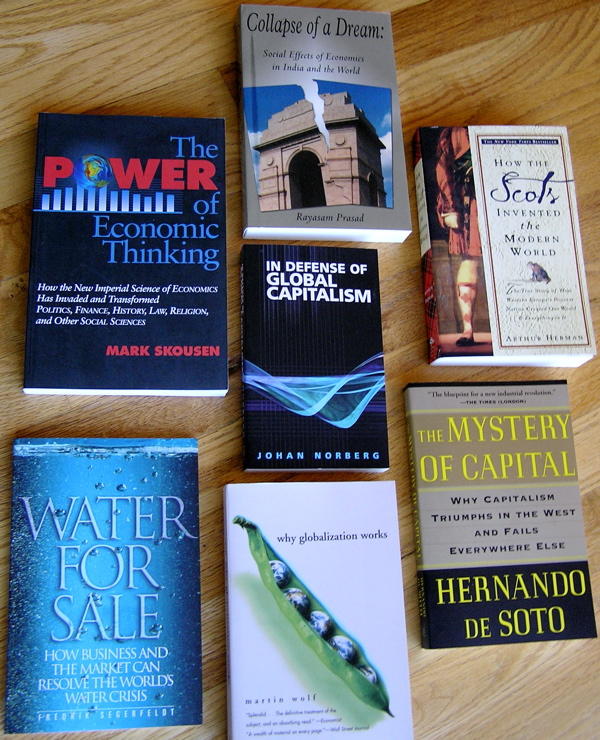
After I returned to the US I arranged for copies of “The Mystery of Capital” by Hernando de Soto to be sent to the academic team to read and discuss. The principles discussed in this book could be powerful if applied to the large extra legal sector in Malawi. The current food shortage crisis in Malawi was not only due to drought but also due to wrongheaded interventions from the state as well as economically stifiling tax policies.

Given the simple, low overhead, non-governmental structure of this group I met with and their desire to learn more about free markets, I hope they will be able to start learning more about classical liberalism and how it might apply in Malawi. Most if not all of the statist and NGO interventions have not worked in the past...why not try freedom?

Saturday, December 03, 2005

I was at this prison in September this year-Great reading

This recent NYT article gives a great overview of Malawi's prison system. It is worthwhile reading.

http://www.wehaitians.com/wasting%20away%20a%20million%20wait%20in%20african%20jails.html

Larry

Thursday, December 01, 2005

AIDS: 1 in 9 Malawians infected

AIDs effects 1 in 9 Malawians. In one academic department within the past three years, three faculty members have apparently died due to complications due to AIDs. Can you imagine the ripple effect this generates. This leaves a huge teaching load for the remaining faculty members as colleges are not hiring new faculty to replace the ones lost to AIDs.

During our discussions I told the group in order to maintain credibility they will need to install and maintain procedures to ensure honesty for personnel and accountability for any grant funds or in-kind support. I also informed them that no western sponsor or donor will put up with any shady dealings similar to what has occurred between the NGO sector, many of the power elites, and the Government. A couple academics estimated that many NGO grants in some sectors can have a 25% “leakage factor.” This is unfortunate as many great projects that would promote longer term self sufficiency are going unfunded due to a "corruption cloud" that hovers over some of Malawi's non-profit sector.

Wednesday, November 30, 2005

More Malawi updates - some thoughts

More notes since I have returned to the US. I have purposely kept out names and locations to protect many of those I met. Malawi still does not have substantial freedom of speech or freedom of the press.

I don't know if I mentioned that the 36 students I taught were mostly from Malawi but some were from Sierra Leone, Uganda, and Zambia. The course was partially sponsored by Economic Thinking/E Pluribus Unum Films, Laissez Faire Books, and the Foundation for Economic Education.

During my Malawi trip I had the privilege of meeting with a group of academcs studying the informal/extralegal sector. They have some libertarian leanings as they have seen the ongoing failures of statism and are open to the philosophy of liberty. During my visit to their campus we discussed the philosophy of liberty, current political and economic climate in Malawi and the political and economic future. I sensed that they were not starting this fledgling think tank for a meal ticket but wanted to effect positive change for Malawi’s future by laying a philosophical foundation that values liberty over state intervention.

We also began discussions of the many parallels between Malawi and other countries: the punitive tariff system in India and aspects of Peru’s economy as described in “The Mystery of Capital” by Hernando De Soto. I told them to mostly look to these nations for models to study and possibly adapt to Malawi. They each have copies of de Soto's book now and are studying it to determine potential "next steps."

...more later

Thursday, September 22, 2005

Last update from Lilongwe--super slow internet connection

We are on our way home tomorrow (Friday)

I have not had the chance to get on oline this past week but will try to catch up once I get back to Seattle.

A lot has happened. Last week I was able to fly and drive to meet some budding “young turks” who are interested in Classical Liberalism. I met about 7 academics and graduate students at a well known Malawi college. They are forming a private think tank to operate with low overhead outside the official university umbrella but still using some of the college resources. We discussed Hernando de Soto at length. I will be sending them many books when I return. My sponsors will make the determination of what sort of next step might be taken.

They are willing and able to help take the longer term steps to building the academic infrastructure for long term change both in terms of encouraging liberty in Malawi and reforming institutions.

I had a chance to get acquainted with Malawi banking, the Malawi federal reserve system, construction, public works, other NGOs, and some local agriculture. I hope to write more later.

Today, I said goodbye to most of my students.

I also had the opportunity to visit one of the worst prison facility (Malua) I have ever heard of. We treat our animals far better than any of these inmates. Think of 130 men in 1100 square foot enclosed buildings – no beds, only concrete floors. The men each have about 6 square feet each. The conditions are abysymal. But I saw some joy as they sang gospel songs that I have seldom seen anywhere else…go figure.

We leave Lilongwe Friday and should be back in Seattle late Saturday.

Wednesday, September 14, 2005

Lilongwe Update #2

Malawi update #2 (9-14-05)

Since my last post so much has happened. We completed NGO-Economics, Class session #3 yesterday and last night we showed the movie “Cromwell.” Students had many questions to discuss and write about that included: “Why does Cromwell argue for a more enlightened government based on true representation of the people…who prefer to be asked not told?”, “Why does Cromwell say”…every man who wages war believes God is on his side.” etc

The students are eager to learn about recent global economic trends and how they effect Malawi.

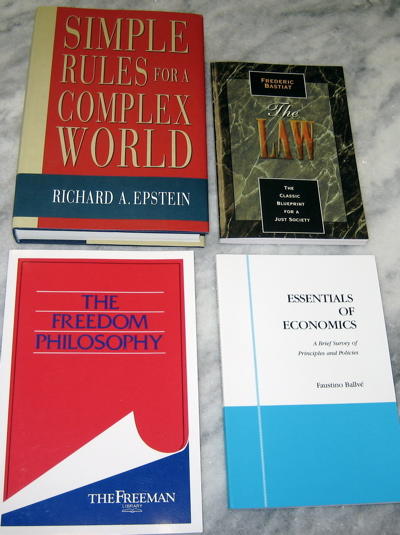
We had fun discussing “the Law” and are working on “What every student should know about economics and prosperity.” This week they are working on writing grant proposals for NGO projects. I am drilling into their minds basic economic principles that so many NGOs ignore to their peril. We had lengthy discussion on incentives, property, and legal plunder based partly on Bastiat’s “The Law” and on Tom Bethel’s book “the Nobelest Triumph-property and prosperity through the ages.” The discussion on the free rider problem and how NGOs can create dependency was especially illuminating. They range in ages from 22 up to 38. The ones who have lived and worked for 5 or more years outside of secondary school are very motivated to lelarn all they can in their last year as seniors.

I miss my wife as she is still away at the Monta Pila village doing educational day care and feeding for AIDs orphans who are served by the Ministry of Hope. I am looking forward to seeing her Thursday evening when she returns back to the college campus.

On Monday evening I met Mr. N., Mr R, and Mr. A. who have started an institute with offices at a well known college. They seem to have set up their organization to have a lot of flexibility to allow them to keep their overhead down but also with enough capacity to hand large research, academic, and educational outreach projects. They have several economists, philosophers, political scientists, a law professor (I think) and a researcher in conflict management. We had a several hour meeting at a Lilongwe hotel not far from the campus where I am staying. Only one of them knew about Hernando de Soto’s worl in South America. We had a fruitful discussion about what Malawi could learn from South America. Religion did not come up. They don’t seem to have any underlying Marxist paradigm so that is promising. I have booked a flight to fly down Thursday to meet their entire team and to learn more about their institute. …we shall see.

I plan on meeting someone in the local construction industry tonight (Wednesday). He is a family friend of a Malawian I know from the Seattle area.

It has been fascinating to learn more about Malawi’s growing informal or extra lelgal sector. In neighboring Zambia it is estimated that only 10% of people work in the legal sector with the remainder working in the informal sector.

Mr. K estimated that in Malawi maybe 7-8% work in the legal sector with the balance working in the informal sector. Malawi has a huge opportunity to institute long term structural reform to make what de Soto calls “dead capital” into “living capital” that can fuel this stalled economy for some real growth that will benefit the average person and not just the power elite.